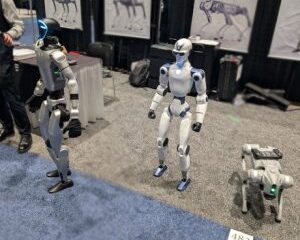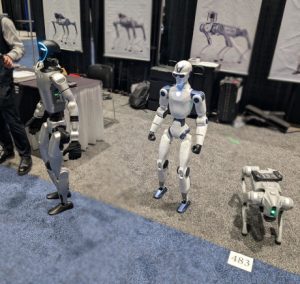

Humanoid robots are no longer just the stuff of lab demos or viral video clips. They are going to work on actual factory floors, handling boxes and moving parts alongside human workers. The latest signal of this shift comes from a deal between British robotics firm Humanoid and German industrial supplier Schaeffler, which plans to deploy up to 2,000 humanoid units at its global manufacturing sites by 2032.
The agreement, reported by Reuters, covers an initial deployment scheduled between December 2026 and June 2027 at two Schaeffler sites in Germany. In Herzogenaurach, the robots will start with box handling tasks. In Schweinfurt, they’ll move into near-full-scale factory testing. Humanoid CEO Artem Sokolov described the timeline as aggressive but achievable, noting that the company will also help integrate the bots into Schaeffler’s existing production lines.
This follows a technology partnership the two companies announced back in January. Under the supply deal, Schaeffler becomes Humanoid’s preferred supplier for joint actuators through 2031, covering more than half of the robot maker’s demand for its wheeled humanoid platforms. Sokolov said the arrangement is expected to cover at least one million actuators over that period. That’s a lot of moving parts, literally.
Physical AI Gets a Real-World Test Bed
Schaeffler’s rollout is part of a broader trend: companies across logistics, hospitality, and retail are turning into test sites for physical AI systems. These are not just software algorithms running in a server room. They are machines that need to grip, lift, fold, and navigate the messy, unpredictable world of human workspaces.
South Korean AI startup RLWRLD, for instance, is collecting worker motion data from hotels, logistics sites, and retail settings. At Lotte Hotel Seoul, food and beverage staff have been recorded while folding banquet napkins and preparing tableware. Body cameras strapped to heads and hands capture how workers move and grip objects during detailed service tasks. The company also logs movement from logistics workers at CJ, tracking how they lift and handle goods in warehouses. It is even working with staff at the Japanese convenience store chain Lawson to study how food displays are organized.
RLWRLD is building an AI software layer for robots that can operate in factories and other worksites. Its engineers have identified hand dexterity as the bottleneck for industrial and service tasks. Because let’s face it: a robot that can weld a car frame is impressive, but one that can fold a napkin without tearing it is a different kind of challenge.
Teaching Robots Through Human Movement
To train its systems, RLWRLD converts worker footage into machine-readable data. Engineers then add their own demonstrations using cameras, VR headsets, and motion-tracking gloves. The data captures details like joint angles and the level of force applied during a task, according to Song Hyun-ji from RLWRLD’s robotics team.
The company then uses that data to train test robots, including systems guided by human operators wearing control devices. In one demonstration, a wheeled robot with human-like metal hands moved cups at a minibar while guided by engineers. In another, a humanoid opened a box, placed a computer mouse inside, closed the lid, and set it on a conveyor belt. It sounds almost mundane. But for a robot to coordinate that sequence of actions without crushing the mouse or knocking over the box is a small miracle of engineering.
RLWRLD sees industrial deployment as the first real target. It expects AI robots for industrial use to be deployed at scale around 2028, a timeline it says is shared by some major businesses.
From Assembly Lines to Hotel Rooms
Hyundai Motor plans to introduce humanoids built by Boston Dynamics (which it owns) at its global factories in the coming years, starting with its Georgia plant in 2028. Samsung Electronics has said it plans to convert all manufacturing sites into “AI-driven factories” by 2030, with humanoids and task-specific robots on the production line.
Meanwhile, Lotte Hotel is looking at robots for cleaning and other back-of-house work. Current humanoids would need several hours to clean a guest room that human workers complete in about 40 minutes. Yes, you read that right: hours vs. 40 minutes. But the hotel hopes robots will be ready for some cleaning and support tasks by 2029. It is even considering robot rental services for hospitality and other service industries.
Park, one of the hotel workers involved in the training process, predicted that humanoids might eventually take over about 30% to 40% of back-of-house event preparation work. He added that tasks involving direct human interaction would remain difficult to replace. Which is probably a relief to anyone who has ever had to ask a hotel front desk for an extra towel.
Labor Concerns and the Human Cost
Not everyone is celebrating. Labor groups in South Korea have raised concerns about the use of worker data and robot deployment. Unions have warned that robot deployment could affect employment and weaken the pipeline for skilled labor. Kim Seok, policy director at the Korean Confederation of Trade Unions, said employers and the government should engage with workers over AI adoption. He added that skilled work remains a human achievement. Fair point.
The tension is real. Companies want efficiency and consistency. Workers want job security and fair treatment. The question is whether physical AI can augment human capability without eroding human dignity. It’s the kind of problem that won’t be solved by better sensors alone.
As humanoids edge closer to factory floors and hotel corridors, the next few years will determine whether this technology becomes a quiet assistant or a disruptive force. One thing is certain: the data is already being collected, the actuators are being ordered, and the robots are learning to fold napkins, one joint angle at a time.