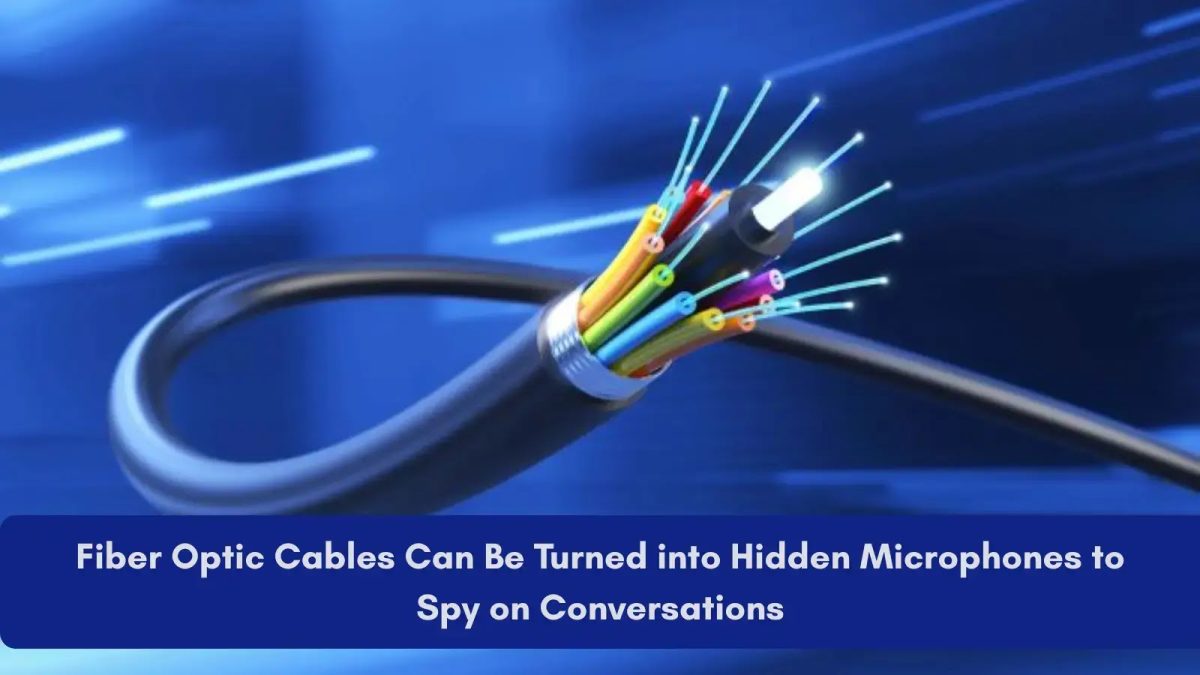

A New Frontier in Acoustic Surveillance
For decades, fiber optic cables have been the gold standard for secure, high-speed data transmission. Their reliance on pulses of light, rather than vulnerable electrical signals, has fostered a deep-seated trust in their inherent privacy. That foundational belief is now being challenged by a startling revelation from the research community. A groundbreaking 2026 study has demonstrated that these very same strands of glass can be repurposed into highly sensitive, undetectable microphones, capable of eavesdropping on private conversations from surprising distances.
The Science of Listening Through Glass
The technique exploits a fundamental principle of physics: sound is vibration. When we speak, our voices create pressure waves that travel through the air and cause imperceptible tremors in surrounding objects, including the fiber optic cables snaking through our walls. These vibrations induce microscopic deformations in the cable’s structure, changes far too small for the human eye to see. Yet, for the laser light traveling within the fiber’s core, these nanoscale disturbances are anything but insignificant.
They subtly alter the phase of the light signal, a phenomenon known as phase modulation. This is where the magic, or rather the menace, happens. By connecting a device called a Distributed Acoustic Sensing (DAS) system to the far end of a standard Fiber-to-the-Home (FTTH) connection, an attacker can monitor these minute phase changes. The DAS system acts as an interpreter, meticulously decoding the optical perturbations and reconstructing them back into audible sound. In essence, the passive cable is transformed into an active acoustic sensor, “hearing” its environment through touch.
From Lab Curiosity to Stealthy Threat
The researchers, hailing from The Hong Kong Polytechnic University and partner institutions, didn’t stop at proving the concept. They engineered a practical and disturbingly stealthy attack vector. To boost sensitivity, they coiled approximately 15 meters of spare fiber around a small plastic cylinder. This compact assembly can be easily concealed inside a common wall-mounted internet termination box, a piece of hardware most people never think to inspect.
In real-world office tests, this setup successfully captured intelligible speech from up to two meters away. When the raw audio was processed through modern AI-powered speech recognition tools, the system could reconstruct over 80% of the spoken content. But it doesn’t stop at voices. The method proved adept at detecting a symphony of other activities: the distinct rhythm of footsteps, the rapid clatter of keyboard typing, and even the operational hum of household appliances. In some scenarios, it could even help triangulate a speaker’s location within a room.
The Undetectable Eavesdropper
Perhaps the most alarming aspect of this surveillance method is its ghost-like nature. Unlike traditional electronic bugs or wireless transmitters, this technique is entirely passive on the target’s premises. It doesn’t broadcast radio frequencies (RF), making it invisible to standard RF scanners and sweepers used by security professionals. It’s also immune to ultrasonic jammers, devices designed to confuse microphones with high-frequency noise.
The attack’s reach is another concern. While initial physical access to the network infrastructure is required, perhaps at a junction box in a building’s basement, the interrogation can happen from up to 50 meters away through the optical network itself. This combination of stealth, resilience in noisy environments, and remote operation elevates it from a theoretical curiosity to a tangible risk, particularly in sensitive corporate or government settings where fiber is ubiquitous.
Securing the Strands of Communication
So, what can be done to mitigate this novel threat? The solution lies in both physical and optical countermeasures. Experts suggest a simple first step: manage your cable slack. Excess loops of fiber coiled behind routers or junction boxes act as perfect, sensitive antennas for sound. Minimizing this exposed length directly reduces acoustic sensitivity.
For higher-security environments, adding sound-dampening materials around critical infrastructure can help absorb vibrational energy before it reaches the cable. On the technical side, the strategic use of optical isolators or circulators within the network can prevent back-reflected light from carrying the stolen acoustic data back to the attacker’s DAS interrogator. It’s a reminder that in security, defense must evolve as creatively as offense.
Rethinking Trust in Infrastructure
This discovery forces a paradigm shift. We’ve long categorized threats as either digital (malware, hacking) or physical (hidden cameras, bugs). This technique blurs that line completely, using physical infrastructure as a conduit for a deeply personal intrusion. It asks an uncomfortable question: how many other assumed-to-be-benign systems in our environment have latent sensory capabilities waiting to be unlocked?
The future of privacy and security will increasingly involve auditing not just for electronic emissions, but for physical susceptibility. As sensing technologies become more sophisticated, the very bones of our buildings and networks may need to be designed with a new kind of silence in mind. The era of assuming our walls don’t have ears just got more complicated, especially when those walls are filled with strands of glass silently carrying our light, and now, potentially, our words.